PROTAC Delivery System Design
* Please be kindly noted that our services and products can only be used for research to organizations or companies and not intended for any clinical or individuals.
Although PROTACs have opened new possibilities for degrading disease-relevant proteins, many candidates still face substantial delivery barriers during discovery and development. High molecular weight, elevated polarity, limited membrane permeability, non-specific tissue distribution, and insufficient intracellular release can all reduce degrader performance and complicate lead optimization. At BOC Sciences, we provide specialized PROTAC delivery system design services to help clients translate promising degraders into more practical and better-performing research candidates. Our scientists integrate PROTAC design services, carrier engineering, formulation strategy selection, and mechanism-based validation to create delivery solutions tailored to the physicochemical profile, biological objective, and target tissue context of each project.
Request a Consultation Explore ServicesWhat is PROTAC Delivery System Design?
PROTAC delivery system design refers to the rational engineering of carriers, conjugation formats, release mechanisms, and formulation parameters that improve how a PROTAC is transported, protected, internalized, and released at the site of action. Unlike conventional small-molecule optimization alone, delivery design focuses on overcoming the intrinsic developability challenges of bifunctional degraders, including poor aqueous behavior, inadequate cellular entry, unstable systemic exposure, and weak tissue selectivity. Depending on the project goal, an effective delivery strategy may involve lipid-based systems, polymeric nanoparticles, self-assembled materials, antibody- or aptamer-guided delivery, or chemically coupled constructs with stimuli-responsive release features. The final objective is not merely to move the molecule, but to preserve degrader integrity, promote productive intracellular exposure, and support efficient target degradation in relevant biological models.
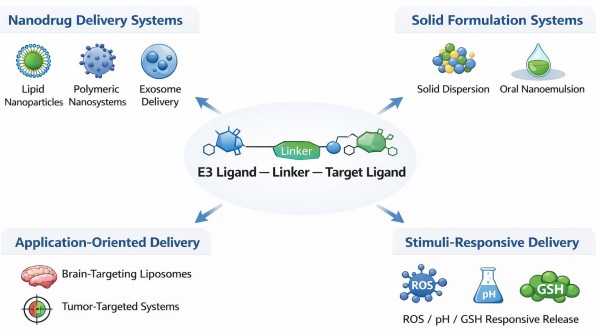 Fig.1 Overview of PROTAC delivery system design strategies (BOC Sciences).
Services
BOC Sciences PROTAC Delivery System Design Capabilities

Delivery Feasibility Assessment
We begin with a project-specific evaluation of degrader size, polarity, solubility behavior, permeability risk, linker accessibility, and target biology. This stage helps determine whether the most suitable path is encapsulation, chemical conjugation, self-assembly, or a hybrid delivery strategy.

Carrier and Formulation Strategy Selection
Our team designs delivery systems based on the needs of each degrader program, including lipid-based vehicles, polymeric nanoparticles, micellar systems, protein-guided carriers, and ligand-directed formulations. We focus on loading efficiency, dispersion behavior, stability, and intracellular delivery potential.

Linker Design and Optimization
Linker architecture is often central to a successful delivery platform. We optimize linker length, polarity, attachment position, and cleavable motifs to balance carrier compatibility, release efficiency, and preserved degrader activity after internalization.

Payload Adaptation and E3 Ligase Compatibility
For delivery-oriented redesign, we can adjust degrader topology, exposed functional groups, and ligase-facing elements to improve formulation tolerance without compromising degradation logic. Our experience in ligand design for E3 ligase supports payload refinement for stable and effective system integration.

Targeted and Stimuli-Responsive Delivery Design
We develop targeted delivery concepts that improve localization and intracellular release by incorporating receptor-binding ligands, peptide motifs, aptamer guidance, or environment-responsive elements. These strategies are designed to increase productive degrader exposure while minimizing unproductive distribution.

Functional Validation and Delivery Performance Testing
Delivery system candidates are evaluated for uptake behavior, payload release, target engagement, and degradation performance using a combination of PROTAC in vitro evaluation, cell-based readouts, and mechanistic assays tailored to your biological model.
Need a Delivery Strategy That Matches Your PROTAC?
We help transform challenging degraders into workable research candidates through tailored carrier selection, linker engineering, and intracellular release design.
Delivery Systems
Our Tailored PROTAC Delivery Systems
Nanodrug Delivery Systems
We develop diversified nanodrug delivery platforms to improve the solubility, intracellular transport, and controlled release behavior of PROTAC molecules. These systems are especially valuable for payloads with poor membrane permeability, high hydrophobicity, or limited bioavailability.
- Lipid-based nanoparticles
- Polymeric nanosystems
- Exosome-based delivery systems
Solid Formulation Systems
For PROTAC candidates requiring enhanced dissolution and oral formulation adaptability, we offer solid formulation strategies that improve dispersion behavior and support more consistent delivery performance in research applications.
- Amorphous solid dispersions
- Self-emulsifying drug delivery systems
Application-Oriented Delivery Systems
We design delivery systems according to specific application scenarios, enabling route-oriented or tissue-oriented optimization for different PROTAC research programs. These platforms help improve localization, uptake efficiency, and functional exposure in complex biological settings.
- Oral delivery systems (nanoemulsions)
- Brain-targeting liposomes (transferrin- or TAT peptide-modified)
- Tumor microenvironment-targeted systems (folate-modified or cRGD-modified)
Stimuli-Responsive Delivery Systems
To support precise intracellular release and improved delivery selectivity, we engineer stimuli-responsive systems that respond to characteristic biochemical conditions in target environments. These strategies are useful for enhancing payload activation only under desired cellular or microenvironmental triggers.
- ROS-responsive delivery systems
- pH-responsive delivery systems
- GSH-responsive delivery systems
Why Delivery
Why Delivery System Design Matters for PROTAC Programs?
 High Molecular Complexity Reduces Permeability
PROTACs contain at least two ligands and usually exceed 700 Da. Their multiple polar bonds also increase TPSA, which lowers membrane permeability and can increase transporter-mediated efflux.
Poor Solubility and Stability Limit Exposure
Many PROTACs have poor aqueous solubility, which can reduce stability in biological media. Low serum stability and weak cell permeability may further impair PK behavior, bioavailability, and distribution profiles.
Delivery Systems Enhance Intracellular Transport
Well-designed delivery systems can improve uptake, protect PROTAC payloads during transport, and promote intracellular release, helping degraders reach the site where productive protein degradation occurs.
Delivery Strategies Improve Selectivity and Exposure
Targeted and responsive delivery platforms can increase local accumulation, reduce non-productive distribution, and improve exposure in relevant cells or tissues, strengthening degrader performance beyond payload optimization alone.

Workflow
Our PROTAC Delivery System Development Workflow
01
Project Consultation and Delivery Goal Definition
We clarify target biology, degrader format, intended model system, and the major barriers limiting current performance.
02
Payload Property Assessment
The PROTAC is profiled for formulation-relevant and delivery-relevant characteristics to establish an informed design baseline.
03
System Selection and Architecture Design
We choose the most suitable delivery concept, such as encapsulation, conjugation, self-assembly, or targeted carrier integration.
04
Linker and Release Module Optimization
Where needed, linkers and trigger motifs are refined to support stable transport and efficient intracellular payload liberation.
05
Formulation Development and Characterization
We prepare candidate systems and characterize loading, size distribution, stability, release behavior, and structural consistency.
06
Cellular Uptake and Trafficking Evaluation
Candidate systems are examined for internalization efficiency, intracellular behavior, and productive exposure to the target site.
07
Functional Degradation Validation
We connect delivery performance with measurable target degradation, downstream activity, and mechanistic relevance.
08
Data Integration and Optimization Recommendations
A final technical package summarizes design rationale, comparative performance, and actionable next-step recommendations for the project.
Optimize PROTAC Delivery for Better Performance
Partner with BOC Sciences to build delivery systems that improve intracellular access, release behavior, and degrader performance.
Why Choose Us
BOC Sciences Advantages in PROTAC Delivery System Development
Integrated Degrader and Delivery Expertise
We combine payload design knowledge with formulation and carrier engineering, enabling more coherent development strategies.

Flexible Delivery Modalities
Our platform supports nanoparticle, liposomal, conjugated, and targeted delivery concepts rather than a single fixed technical route.
Mechanism-Oriented Optimization
We optimize not only loading and transport, but also the conditions required for successful intracellular degrader release and activity.
Cross-Functional Validation Capability
Formulation, uptake, and degradation are evaluated together so that delivery design decisions are guided by functional outcomes.
Customized Project Execution
We can support stand-alone delivery design tasks or integrate them into broader PROTAC delivery programs according to your research priorities.
Strong Problem-Solving Focus
Our service model is built to address real bottlenecks such as poor permeability, insufficient intracellular accumulation, unstable release, and weak performance translation.
Applications
Applications of PROTAC Delivery System
Cancer Therapy
PROTAC delivery systems can improve the intracellular transport and local accumulation of degraders targeting oncogenic proteins, supporting more effective protein degradation strategies in tumor research.
Neurodegenerative Diseases
Specialized delivery platforms can help address transport barriers in neural systems and support the development of PROTAC-based approaches for disease-related protein clearance.
Cardiovascular and Metabolic Diseases
Delivery system design can support targeted exposure and controlled release of PROTAC molecules for research involving cardiovascular dysfunction and metabolic disorder-associated proteins.
Inflammatory and Immune Diseases
PROTAC delivery platforms may enhance the study of immune-regulating or inflammation-related targets by improving degrader stability, uptake, and tissue selectivity.
Infectious Diseases
Optimized delivery systems can facilitate the evaluation of PROTAC molecules designed to modulate host or pathogen-associated proteins involved in infectious disease research.
Delivery System Technology Development
Beyond disease-focused studies, these platforms are also valuable for the development and benchmarking of new carrier technologies, targeted delivery strategies, and responsive release systems for PROTAC programs.
Case Study
Client Success Stories: PROTAC Delivery System Development
Project Background
A client had identified a potent PROTAC lead with strong biochemical activity, but the free molecule showed poor aqueous dispersion and inconsistent degradation performance in cell-based studies. The project goal was to identify a delivery system that could improve stability, cellular uptake, and intracellular release without changing the core degrader pharmacology.
Technical Challenges
The PROTAC displayed high hydrophobicity, aggregation tendency during formulation, and weak translation from biochemical potency to cellular degradation efficiency.
BOC Sciences Solutions
- Systematic Physicochemical Screening: We first analyzed solubility, polarity, aggregation tendency, carrier compatibility, and release-related properties of the PROTAC to define the major formulation barriers.
- Parallel Carrier Comparison: Multiple delivery approaches, including lipid nanoparticles, polymeric nanosystems, and self-assembled formulations, were prepared and compared side by side for payload loading, particle stability, dispersion behavior, and release performance.
- Uptake and Functional Validation: Candidate systems were further ranked through cellular uptake studies, intracellular trafficking analysis, and target degradation assays, allowing us to identify the lipid-based system as the most suitable platform for this payload.
Project Outcomes
We evaluated more than 10 delivery prototypes across lipid-based nanoparticles, polymeric nanosystems, and self-assembled formulations. The optimized lipid-based system performed best, showing better encapsulation, stronger dispersion stability, improved cellular internalization, and more efficient intracellular release than the other candidates.
Project Background
A biotech partner was developing a PROTAC program for EGFR-overexpressing tumor cells and needed a targeted delivery strategy to improve selective uptake and intracellular payload exposure while preserving degrader activity.
Technical Challenges
The main challenge was to identify a delivery format that could support receptor-associated transport, maintain system stability, and ensure efficient intracellular release after uptake.
BOC Sciences Solutions
- Targeting Strategy Evaluation: We assessed several targeting concepts, including ligand-modified nanoparticles, peptide-guided systems, and conjugation-based approaches, based on receptor expression, payload compatibility, and expected internalization pathways.
- Linker and Release Module Optimization: Different linker chemistries and cleavable motifs were designed and screened to balance extracellular stability with efficient intracellular payload release.
- Comparative Performance Selection: Through integrated analysis of binding behavior, uptake efficiency, intracellular distribution, and degradation readouts, we identified the most appropriate targeted delivery system for the client's biological model.
Project Outcomes
We compared 8 targeted delivery candidates, including ligand-modified nanoparticles, peptide-guided systems, and conjugation-based formats. The peptide-guided system showed the best balance of cell-selective uptake, intracellular exposure, release efficiency, and degradation performance in EGFR-overexpressing tumor cells.
Frequently Asked Questions (FAQ)

Why does PROTAC need delivery system design?
PROTAC is not a modality where biological activity alone is enough to support development. Many PROTAC molecules have relatively high molecular weight, elevated polarity, and complex structures, which often create challenges in cell permeability, exposure, tissue distribution, and formulation compatibility. As a result, delivery system design can directly affect whether a candidate is practically developable. For drug development clients, the value of delivery design is not simply to “package the molecule,” but to balance developability, target tissue exposure, and molecular stability so that the degradation potential of the PROTAC can be translated into a workable development strategy.
What should PROTAC delivery design address first?
In practice, the first priority is usually not a single parameter, but whether the molecule can reach cells and function at the right intracellular site. That means early development should focus on cell uptake, membrane permeability, molecular stability, tissue distribution tendency, and the extent to which formulation can improve exposure. Many projects do not stall because the target biology is wrong, but because the delivery route does not match the molecular properties. Once the main limiting factor is identified—whether absorption, transport, release, or intracellular accessibility—the team can more rationally decide whether to use lipid-based systems, polymeric nanoparticles, prodrug strategies, or other formulation optimization approaches.
Is nanodelivery suitable for every PROTAC project?
Not necessarily. Nanodelivery can help some PROTAC molecules improve stability, exposure, and tissue accumulation, and it is often considered when the molecule has clear physicochemical limitations. However, it should not be treated as the default solution for every project. Whether a nano-based approach is appropriate depends on the target tissue, dosing scenario, loading behavior, release mechanism, and scalability potential. In some programs, linker optimization, prodrug design, or conventional formulation screening may be more effective than moving immediately into a complex carrier system. For this reason, an experienced drug development service provider such as BOC Sciences can add value by conducting early-stage physicochemical assessment, carrier compatibility screening, and formulation feasibility studies to help clients determine whether nanoPROTAC development is the right path.
How can intracellular delivery of PROTAC be improved?
Improving intracellular delivery is not simply a matter of increasing dose. The key is to optimize the full process of cellular entry, minimizing loss before productive activity, and enabling efficient intracellular release. Common strategies include improving permeability and lipophilic balance at the molecular level, refining linker design and overall conformation, and using lipid or polymer-based nanoparticles to enhance uptake through endocytosis. In some cases, cleavable release mechanisms can further improve effective intracellular payload utilization. For clients seeking to accelerate screening and reduce development uncertainty, BOC Sciences can support formulation screening, nanoparticle development, and the evaluation of encapsulation and release behavior, helping move a project from a molecule with promising activity to one supported by practical delivery data.
How to choose a PROTAC delivery platform?
A suitable PROTAC delivery platform should not be selected simply because a technology is popular. It should be chosen because it fits the actual needs of the molecule and program. Key considerations typically include physicochemical properties, target tissue requirements, administration route, drug loading capacity, release behavior, system stability, and the potential difficulty of later process scale-up. For PROTACs in particular, the platform must do more than carry the molecule; it must also preserve intracellular accessibility and support the mechanism required for target degradation. In this context, BOC Sciences can help clients by comparing delivery strategies based on molecular characteristics and supporting formulation design and verification studies, which can reduce trial-and-error during platform selection.
Testimonials
Client Feedback on Our PROTAC Delivery Design Services
Strong Formulation Problem Solving
"Our degrader series had excellent concept-level promise but very poor formulation behavior. The BOC Sciences team proposed a practical delivery strategy that gave us much clearer cell-based data and a more confident optimization direction."
— Dr. Wilson, Senior Scientist at a US-Based Biotech Company
Helpful Integration of Chemistry and Biology
"What stood out was their ability to connect linker chemistry, delivery architecture, and degradation readouts into one coherent workflow. That saved us substantial effort during project refinement."
— Dr. Bennett, Project Leader at a European Drug Discovery Team
Customized Delivery Strategy
"Rather than forcing a standard platform, BOC Sciences built a delivery design around our specific PROTAC and biological question. The resulting system gave us much better insight into what was limiting performance."
— Dr. Carter, Principal Investigator at a Translational Research Program
Reliable Functional Validation
"Their team did more than prepare formulations. They clearly demonstrated which delivery setup improved uptake and which one actually translated into stronger degradation, which made the project much easier to prioritize."
— Mr. Harrison, Discovery Manager at a Global Pharmaceutical Research Group
* PROTAC® is a registered trademark of Arvinas Operations, Inc., and is used under license.
BOC Sciences Support
Please contact us with any specific requirements and we will get back to you as soon as possible.

