E3 Ligase Ligand-Linker Conjugate
* Please be kindly noted that our services and products can only be used for research to organizations or companies and not intended for any clinical or individuals.
By E3 Ligase
By Functional Group
By Formula Weight
Filtered by
Clear All





Background
What Are E3 Ligase Ligand-Linker Conjugates?
E3 ligase ligand-linker conjugates are preassembled building blocks used in targeted protein degradation research. They combine an E3 ligase recruiting motif with a linker segment and leave a functional handle available for coupling to a target-binding ligand. In a typical PROTAC workflow, this format represents the E3-recruiting half of a bifunctional degrader, allowing researchers to focus on connecting the prepared conjugate to a selected ligand for the protein of interest.
For discovery chemistry, chemical biology, and protein degradation teams, E3 ligase ligand-linker conjugates simplify the practical assembly of degrader candidates. Instead of sourcing a free E3 ligase ligand and a separate linker, then optimizing the first conjugation step from the beginning, researchers can use a ready-to-couple intermediate that already contains the E3 ligand and linker architecture. This approach helps reduce design complexity, improve analog planning, and support more structured comparisons across E3 ligase recruitment strategies.
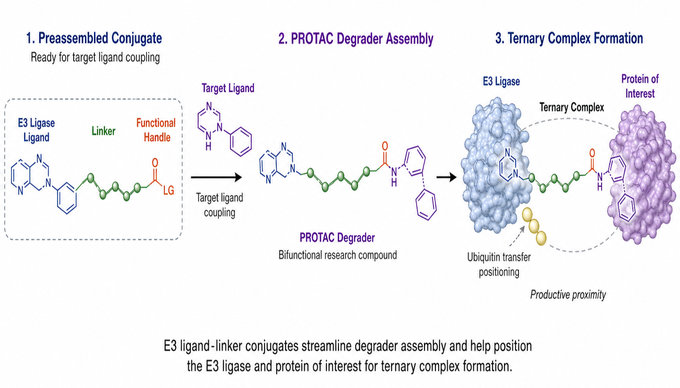 Fig.1 E3 ligase ligand-linker conjugate contribution to degrader assembly and ternary complex formation (BOC Sciences Original).
Advantages of E3 Ligase Ligand-Linker Conjugates
01
Convenient Starting Points for PROTAC Assembly
E3 ligase ligand-linker conjugates provide a prepared E3-recruiting unit that can be directly connected with suitable target ligands. This helps researchers avoid rebuilding the same E3 ligand-linker fragment for every degrader design. By simplifying one side of the PROTAC structure, these conjugates make compound assembly more organized and practical for early-stage degrader exploration.
02
Reduced Repetitive Synthetic Work
When multiple degraders share the same E3 ligase ligand and linker design, preassembled conjugates can reduce repeated synthesis steps. Researchers can use a common intermediate to prepare several analogs, saving effort in route planning, purification, and material preparation. This convenience is especially useful for teams comparing target ligand variants within a focused PROTAC series.
03
Easier Comparison of E3 Recruitment Strategies
E3 ligase ligand-linker conjugates help researchers compare different E3 recruitment designs in a more controlled way. By selecting conjugates based on E3 ligand type, linker length, and functional handle, teams can evaluate how recruitment choice affects degrader behavior. This structured approach makes project decisions clearer and supports more efficient optimization of targeted protein degradation compounds.
04
Practical Support for Library Construction
For degrader library preparation, E3 ligase ligand-linker conjugates offer convenient modular building blocks. They allow researchers to combine a defined E3 side with multiple target-binding motifs, helping generate compound sets with meaningful structural variation. This can improve workflow consistency, simplify procurement planning, and make SAR analysis easier when exploring linker and ligand combinations.
Structural Features of E3 Ligase Ligand-Linker Conjugates
An E3 ligase ligand-linker conjugate contains three key structural elements: the E3 ligase recognition motif, the linker segment, and the terminal functional handle used for coupling to a target ligand. These elements must work together. The E3 ligand should preserve productive ligase recognition, the linker should present an appropriate distance and geometry, and the handle should enable efficient conjugation without undermining the final degrader design.
E3 Ligase Recognition Motifs
The E3 ligase recognition motif is the structural element responsible for recruiting a selected E3 ligase system. In PROTAC research, commonly used recruitment motifs are designed around ligases such as CRBN, VHL, IAP, and MDM2. Each motif has its own binding characteristics, tolerated modification positions, and exit vector preferences. The choice of E3 ligand affects not only binary ligase binding but also how the final degrader can position the target protein relative to the ubiquitination machinery.
Researchers typically evaluate an E3 ligand motif based on its compatibility with the target system, known modification chemistry, and planned degrader architecture. BOC Sciences also provides support for ligand design for E3 ligase projects when teams need to evaluate ligase-binding motifs, modification points, or E3 recruitment strategies before advancing to conjugate preparation.
Linker Length, Flexibility, and Polarity
The linker segment determines the spatial relationship between the E3 ligand and the future target ligand. Length affects reach, flexibility affects conformational sampling, and polarity affects compound handling and assay suitability. PEG linkers are frequently used when flexible and more hydrophilic spacing is desired. Alkyl and alkyl-ether linkers can adjust hydrophobic balance. Aromatic, heteroaryl, cyclic, piperazine, or triazole-containing linkers can introduce more defined geometry.
Because degrader performance depends on ternary complex organization rather than binary binding alone, linker design often requires iterative testing. Researchers may select a small panel of E3 ligand-linker conjugates that differ in length, flexibility, or rigidity, then connect them to the same target ligand to understand how linker chemistry changes degradation behavior.
Functional Handles for Target Ligand Coupling
The terminal handle is the site that enables connection to a target ligand. Common coupling handles may include amines, carboxylic acids, alkynes, azides, alcohols, activated groups, or other compatible functional groups. The handle should match the available chemistry on the target ligand while preserving the structural logic of the intended degrader.
Handle selection can influence the efficiency of analog synthesis and the final bond type within the degrader. For example, an amine-bearing conjugate may support amide formation with a target ligand acid, while an alkyne or azide handle may support modular assembly when the target ligand contains the complementary group. BOC Sciences can help researchers align conjugate selection with available target ligand chemistry and planned analog design.
Exit Vector Design and Attachment Compatibility
Exit vector design refers to the direction in which the linker leaves the E3 ligand and later connects to the target ligand. A productive exit vector should preserve essential ligase-binding interactions while directing the linker toward a geometry that can support ternary complex formation. Attachment compatibility is equally important on the target ligand side, where modification should avoid disrupting key target-binding contacts.
When structural information is available, exit vector selection can be guided by solvent exposure, binding pocket orientation, and modeled protein proximity. When structural information is limited, researchers often compare several conjugates with different linkers or attachment strategies. The goal is to create a degrader series that is chemically feasible and informative for understanding target–E3 alignment.
Common Types of E3 Ligase Ligand-Linker Conjugates
E3 ligase ligand-linker conjugates can be organized by the ligase system they are designed to recruit. Each class provides a different entry point into degrader design and may require different linker lengths, exit vectors, and coupling strategies. The following categories help researchers compare available options without assuming that one ligase system will be suitable for every target.
CRBN Ligand-Linker Conjugates
CRBN ligand-linker conjugates are widely used in PROTAC research because CRBN-recruiting motifs have well-characterized positions for linker attachment. These conjugates can support the synthesis of degrader analogs in which the E3 recruitment side remains consistent while the target ligand, linker length, or coupling chemistry is varied. They are especially useful for researchers building focused degrader sets around a defined target ligand.
For projects centered on CRBN recruitment, BOC Sciences provides product and service support related to CRBN-based PROTAC development. Researchers may choose CRBN ligand-linker conjugates when they need practical intermediates for rapid analog construction, E3 comparison, or structure–activity relationship exploration.
VHL Ligand-Linker Conjugates
VHL ligand-linker conjugates provide another important route for E3 ligase recruitment in degrader design. They are often evaluated alongside CRBN-oriented conjugates because the same target ligand can show different degradation behavior depending on which E3 ligase is recruited and how the ternary complex is organized. VHL conjugates can include different linker compositions to explore distance, geometry, and physicochemical balance.
BOC Sciences supports research workflows involving VHL-based PROTAC development. These conjugates can help teams compare ligase recruitment options and build matched analogs that clarify whether the target protein responds better to one E3 recruitment strategy than another.
IAP Ligand-Linker Conjugates
IAP ligand-linker conjugates are designed to recruit inhibitor of apoptosis protein family ligases in targeted protein degradation research. They can be useful when a project aims to explore ligase systems beyond the most commonly used CRBN and VHL routes. Because IAP-oriented degraders may require careful attention to molecular architecture, linker design and target ligand compatibility are important selection factors.
Researchers working with IAP recruitment may use these conjugates to compare linker chemotypes, evaluate target ligand coupling options, and build degrader analogs for mechanistic studies. BOC Sciences also provides support related to IAP-based PROTAC development for teams that need a broader E3 recruitment strategy.
MDM2 Ligand-Linker Conjugates
MDM2 ligand-linker conjugates support projects where MDM2 recruitment is part of the degrader design plan. These conjugates provide a prepared E3-recruiting unit connected to a linker and functional handle, enabling researchers to connect the motif to selected target ligands. As with other E3 systems, the value of MDM2-oriented conjugates depends on whether the final degrader can form a productive target–ligase assembly.
BOC Sciences offers technical support for research involving MDM2-based PROTAC development. Such support can help teams evaluate whether MDM2 recruitment, linker chemistry, and target ligand attachment are aligned with the intended degrader design.
Linker Types in E3 Ligase Ligand-Linker Conjugates
BOC Sciences provides E3 ligase ligand-linker conjugates with diverse linker options, including structures classified by chemical composition, functional properties, E3 ligand-based linker formats, and specialized design formats. These linker choices help researchers compare available conjugates more clearly and select suitable E3-side building blocks for modular PROTAC construction, linker screening, and target ligand coupling.

Classification by Chemical Structure
Chemical structure is the most direct way to compare linker options in E3 ligase ligand-linker conjugates. Different chemotypes influence linker length, flexibility, polarity, rigidity, and synthetic compatibility, allowing researchers to build structurally diverse degrader analogs around a selected E3 recruitment motif.
- PEG Linkers
- Alkyl Linkers
- Alkyl-Ether Linkers
- Aromatic Linkers
- Heteroaryl Linkers
- Triazole Linkers
- Piperazine Linkers
- Cyclic or Semi-Rigid Linkers

Classification by Functional Properties
From a functional perspective, linkers are selected according to the role they play in PROTAC assembly and degrader optimization. Some linkers mainly adjust molecular spacing, while others improve conjugation convenience, introduce defined geometry, or provide reactive handles for coupling with target protein ligands.
- Flexible Spacing Linkers
- Rigid Orientation-Control Linkers
- Hydrophilic Linkers
- Hydrophobic Balance Linkers
- Amine-Terminated Linkers
- Carboxylic Acid-Terminated Linkers
- Azide- or Alkyne-Functionalized Linkers
- Cleavable Linker Designs
Classification by E3 Ligand-Based Linker Formats
In E3 ligase ligand-linker conjugates, "E3 ligand-based linkers" refer to linker formats preassembled with a selected E3-recruiting ligand. This classification helps researchers compare conjugates according to E3 recruitment direction while still evaluating linker length, exit vector compatibility, terminal handle, and coupling strategy.
- CRBN Ligand-Based Linkers
- VHL Ligand-Based Linkers
- IAP Ligand-Based Linkers
- MDM2 Ligand-Based Linkers
- DCAF Ligand-Based Linkers
- RNF Ligand-Based Linkers
- TRIM Ligand-Based Linkers
- Custom E3 Ligand-Based Linkers
Specialized Linker Types
Specialized linker formats are used when standard PEG, alkyl, or rigid linkers cannot fully address the desired molecular architecture. These designs may support multicomponent conjugation, hybrid degrader concepts, biomolecule-associated formats, or customized research tools requiring more tailored linker behavior.
- PROTAC-ADC Hybrid Linkers
- Dual-Payload Linkers
- Carbohydrate-Based Linkers
- Peptide Linkers
- Nucleic Acid Aptamer Linkers
- Multifunctional Linkers
- Branched Linkers
- Custom Hybrid Linker Designs
E3 Ligase Ligand-Linker Conjugates vs. PROTAC Linkers and E3 Ligase Ligands
E3 ligase ligands, PROTAC linkers, and E3 ligase ligand-linker conjugates play different roles in modular degrader construction. Understanding their definitions and structural levels helps researchers choose the most suitable building block for target ligand coupling, linker optimization, E3 recruitment comparison, or early PROTAC library preparation.
| Term | Definition | Structural Nature |
| E3 Ligase Ligand | A small-molecule ligand that specifically binds an E3 ubiquitin ligase. | A single functional module, such as a VHL ligand or CRBN ligand. |
| PROTAC Linker | A chemical bridge that connects an E3 ligand with a target protein ligand. | A single structural module, such as a PEG chain, alkyl chain, or nitrogen-containing heterocyclic linker. |
| E3 Ligase Ligand-Linker Conjugate | A complete functional unit formed by pre-connecting an E3 ligand with a linker. | A dual-module conjugate that can be directly coupled with a target protein ligand to construct a PROTAC molecule. |
Different Functional Levels
These three product types differ mainly in functional completeness. An E3 ligase ligand-linker conjugate is more advanced than a free E3 ligand or standalone linker because it combines E3 recognition with a prepared linker and coupling-ready position.
- E3 Ligase Ligand: Responsible only for E3 recognition and recruitment; it does not provide a linker function by itself.
- PROTAC Linker: Provides spatial distance and conformational flexibility, but does not contain an E3-binding motif by itself.
- E3 Ligase Ligand-Linker Conjugate: Combines E3-binding capability with a linker and reactive connection point, serving as a practical "half-built" PROTAC component.
Different Application Scenarios
Selection depends on whether the project needs a free recognition ligand, an independent linker, or a preassembled E3-side module. Matching the product type to the workflow can make synthesis planning and analog preparation more convenient.
- E3 Ligase Ligand: Suitable for SAR research on the E3-binding motif itself, especially when researchers need to evaluate how structural changes affect E3 recognition before linker attachment.
- PROTAC Linker: Suitable for optimizing linker length, polarity, rigidity, and functional handles when the E3 ligand is fixed and researchers need to rebuild conjugates with different spacer designs.
- E3 Ligase Ligand-Linker Conjugate: Suitable for de novo PROTAC construction when a target protein ligand is available, or for high-throughput E3–substrate pairing studies using a conjugate library with a fixed target ligand.
Looking for E3 Ligase Ligand-Linker Conjugates?
BOC Sciences offers a comprehensive selection of in-stock E3 ligase ligand-linker conjugates to support targeted protein degradation research. If you cannot find the product you need or require customized synthesis, our team is ready to help.
Applications of E3 Ligase Ligand-Linker Conjugates
E3 ligase ligand-linker conjugates can be used across early degrader design, analog synthesis, E3 ligase comparison, and chemical biology tool development. Their value comes from making the E3-recruiting portion of the molecule easier to incorporate into a broader research plan. The same conjugate can be used as a starting point for multiple target ligand couplings, while related conjugates can help map the effects of linker and ligase selection.
PROTAC Synthesis and Degrader Library Construction
E3 ligase ligand-linker conjugates are useful intermediates for preparing PROTAC molecules and degrader libraries. A team can select a set of conjugates with different linker lengths, chemotypes, or ligase motifs, then connect them to one or more target ligands. This approach helps create a structured library that explores meaningful chemical variables rather than a scattered collection of unrelated compounds.
For broader compound set planning, BOC Sciences provides support for linker library construction and degrader building block selection. Such support can help teams design libraries that compare PEG, alkyl, semi-rigid, and functionalized linkers in a practical and interpretable way.
E3 Ligase Recruitment Strategy Comparison
Different E3 ligases can produce different target degradation outcomes, even when the same target ligand is used. E3 ligase ligand-linker conjugates allow researchers to compare recruitment strategies by preparing related degraders that vary mainly on the E3 side. This can help determine whether CRBN, VHL, IAP, MDM2, or another ligase-oriented design is more informative for the target under study.
Such comparisons are particularly valuable when the target protein has limited structural information or when binary target binding does not predict degradation behavior. Using matched conjugates helps keep the comparison focused and reduces the number of uncontrolled design variables.
Structure–Activity Relationship Studies
Structure–activity relationship studies require systematic chemical variation. E3 ligase ligand-linker conjugates support this requirement by enabling researchers to build analog series that isolate the effect of linker length, linker polarity, functional handle position, or E3 ligand identity. A clear analog set can reveal whether a design issue comes from target ligand binding, E3 recruitment, linker geometry, or overall molecular properties.
Matched conjugate sets can also help researchers decide when to move from broad exploration to more focused refinement. For example, early studies may compare several linker classes, while later studies may use closely related conjugates to refine distance, rigidity, or coupling position around a promising degrader structure.
Chemical Biology Tool Development for Protein Degradation Research
E3 ligase ligand-linker conjugates can be used to prepare tool degraders for probing protein function, pathway behavior, and degradation mechanism. They are also useful for negative-control design when the research plan includes matched analogs with altered E3 recruitment or modified stereochemistry. In chemical biology, such matched molecules can help distinguish productive degradation from non-specific compound effects.
BOC Sciences supports chemical biology workflows by helping researchers connect building block selection with practical synthesis and assay planning. This product-oriented approach allows teams to move from a structural concept to a usable compound set while maintaining clear design logic.
How to Select E3 Ligase Ligand-Linker Conjugates for Your Project?
Selecting an E3 ligase ligand-linker conjugate requires more than choosing a familiar E3 ligand. The conjugate must fit the target ligand, planned coupling route, intended linker geometry, and experimental objective. A useful selection process begins with the target ligand structure and modification site, then evaluates which E3 ligand-linker formats can be connected without compromising binding or generating an impractical molecule.
Matching E3 Ligase Selection to Research Objectives
The selected E3 ligase should align with the research objective, target system, available assay format, and desired comparison strategy. CRBN and VHL conjugates are frequently used starting points, while IAP, MDM2, and other ligase-oriented conjugates may be explored when the project requires broader E3 recruitment coverage. The goal is not to choose a ligase based on familiarity alone, but to evaluate whether the ligase can support productive target engagement in the planned degrader architecture.
When a project is still defining its E3 strategy, researchers may benefit from reviewing ubiquitin ligases and related ligase systems before selecting conjugates. This helps connect product selection with the mechanistic role of the E3 ligase in targeted protein degradation.
Choosing Linker Chemistry Based on Target Ligand Compatibility
Target ligand compatibility is often the most important filter for linker chemistry. A linker that is attractive on the E3 side may not work if the target ligand modification site is sterically crowded, chemically unstable, or critical for target binding. Researchers should consider whether a flexible linker can accommodate uncertain geometry, whether a semi-rigid linker may improve orientation, and whether polarity needs to be adjusted for compound handling.
BOC Sciences can support ligand design for target protein workflows when teams need to evaluate modification points before selecting E3 ligand-linker conjugates. This is especially useful when the target ligand was not originally designed for degrader construction.
Evaluating Functional Handles for Conjugation Routes
The terminal handle should match the planned conjugation route and available target ligand functionality. Amine and acid handles are useful for amide-based assembly. Alkyne and azide handles can support modular coupling strategies. Alcohols, activated groups, and other handles may be appropriate depending on the substrate and route. The selected handle should enable efficient synthesis while preserving the final degrader architecture.
Functional handle selection also affects analog planning. If a team intends to compare many conjugates, using consistent coupling chemistry can make the analog set easier to interpret. If the target ligand has limited modification options, custom conjugate preparation may be more appropriate than forcing the design around an unsuitable catalog handle.
Planning Matched Conjugate Sets for Iterative Optimization
A matched conjugate set is often more useful than a single product. Early experiments may compare CRBN and VHL conjugates with similar linker lengths, or compare PEG, alkyl, and semi-rigid linkers using the same E3 ligand. Once a promising direction is identified, later analogs can focus on smaller changes in length, polarity, or attachment chemistry.
Iterative optimization works best when each conjugate is selected to answer a specific design question. BOC Sciences can help research teams organize product options into practical analog sets that support clearer decision-making from early degrader assembly through later refinement.
Product Options for E3 Ligase Ligand-Linker Conjugate Research
BOC Sciences offers E3 ligase ligand-linker conjugates and related building blocks for PROTAC synthesis, degrader library construction, E3 ligase comparison, and custom research needs. Product options may include CRBN-, VHL-, IAP-, and MDM2-oriented conjugates with different linker classes and terminal handles. These options help researchers select building blocks based on actual design requirements rather than treating all ligand-linker conjugates as interchangeable intermediates.
Ready-to-Use Ligand-Linker Conjugates
Ready-to-use ligand-linker conjugates are suitable for teams that already know the target ligand and need an E3-recruiting intermediate for coupling. These products can support early degrader preparation, parallel synthesis, and focused analog generation. Researchers can select products according to E3 ligand class, linker type, linker length, and terminal handle.
This product format is particularly useful when a team wants to reduce repeated synthesis on the E3 side. By selecting a prepared conjugate, researchers can focus resources on target ligand coupling, compound evaluation, and design refinement.
Functionalized Conjugates for Target Ligand Coupling
Functionalized conjugates contain terminal groups selected for coupling with compatible target ligand handles. Depending on the available chemistry, researchers may choose conjugates bearing amines, acids, alkynes, azides, alcohols, or activated groups. This flexibility allows the conjugate to be integrated into different synthetic routes and target ligand modification strategies.
For teams designing new target ligand intermediates, choosing the functional handle early can prevent route conflicts later. BOC Sciences can discuss handle selection in relation to ligand structure, linker design, and intended degrader series.
Conjugates for PEG, Alkyl, and Rigid Linker Exploration
Linker exploration is a central part of degrader design. PEG-containing conjugates can support flexible and more hydrophilic spacing. Alkyl and alkyl-ether conjugates can help adjust hydrophobic balance and molecular compactness. Rigid or semi-rigid conjugates containing aromatic, heteroaryl, triazole, piperazine, or cyclic elements can introduce more defined geometry.
Using a structured panel of conjugates allows researchers to evaluate how the same E3 ligand behaves when the linker environment changes. Related resources such as Understanding the Role of Linkers in PROTAC Molecules: Length, Flexibility, and Efficiency can support teams planning linker-focused experiments.
Custom Conjugate Support for Specialized Research Needs
Some projects require conjugates that are not available as catalog products. A target ligand may need a specific coupling handle, an E3 ligand may require a different exit vector, or a research team may want a matched set of conjugates for a defined SAR plan. Custom conjugate support can address these needs by aligning the building block structure with the intended experimental question.
BOC Sciences offers customized support for specialized ligand-linker conjugate requirements, including linker variation, handle adjustment, and analog set planning. This enables teams to move beyond simple product selection when their degrader design requires a more tailored intermediate.
Why Choose BOC Sciences E3 Ligase Ligand-Linker Conjugates?
BOC Sciences supports targeted protein degradation research with product options and technical expertise aligned with real discovery workflows. Our E3 ligase ligand-linker conjugates are designed to help researchers assemble PROTAC degraders, compare E3 recruitment strategies, and organize linker-focused SAR studies with clearer structural logic. The focus is on practical research value: selecting the right building block, matching it to the target ligand, and supporting a coherent degrader design plan.
 Broad E3 Ligase Conjugate Selection
BOC Sciences provides E3 ligase ligand-linker conjugates covering commonly explored ligase recruitment systems, including CRBN-, VHL-, IAP-, and MDM2-oriented options. This breadth helps researchers compare ligase strategies and build matched degrader analogs with better control over structural variables.
Product-Oriented Support for Modular PROTAC Assembly
Our team can help researchers evaluate how an E3 ligand-linker conjugate fits into a modular degrader construction plan. This includes discussion of target ligand compatibility, functional handle selection, linker class, and conjugation route.
Custom Building Block and Conjugate Preparation
When catalog products do not match the project design, BOC Sciences can support custom preparation of E3 ligand-linker conjugates, specialized functional handles, and matched analog sets for focused research needs.
Integrated Expertise Across TPD Products and Services
BOC Sciences connects product supply with related expertise in ligand design, linker selection, ubiquitination research, binding evaluation, and degrader activity assessment. This integrated perspective helps teams select conjugates that fit both chemistry planning and downstream research objectives.
Frequently Asked Questions (FAQ)

How do I choose a ligand-linker conjugate?
Start by defining the E3 ligase system, target ligand attachment site, preferred linker length, and compatible terminal handle. CRBN and VHL conjugates are often used for initial comparison, while IAP, MDM2, or emerging ligase modules may be selected for alternative recruitment strategies. BOC Sciences can help researchers compare product options according to conjugation chemistry, linker composition, and intended degradation assay workflow.
Which E3 ligase system should I consider first?
Many projects begin by comparing CRBN and VHL because both systems are widely used in PROTAC research and offer different ligase recruitment geometries. The right starting point depends on the target protein, available target ligand, cell model, and desired degrader profile. Researchers may also explore IAP, MDM2, or newer ligase systems when common ligases do not provide the preferred degradation response.
Why does linker chemistry affect PROTAC performance?
Linker chemistry controls the distance, flexibility, polarity, and orientation between the E3 ligase ligand and the target protein ligand. These features influence whether a productive ternary complex can form and whether the target protein is positioned for ubiquitination. PEG, alkyl, alkyl/ether, and rigid linkers each create different conformational possibilities, so comparing linker classes is a key step in degrader optimization.
Can BOC Sciences support custom conjugate needs?
Yes. When catalog E3 ligase ligand-linker conjugates do not match a project’s desired linker length, terminal handle, or ligase-binding motif, BOC Sciences can discuss custom synthesis options for related degrader intermediates. This is useful for teams exploring unique target ligand exit vectors, emerging E3 ligase systems, or focused analog sets requiring a consistent chemical design theme.
What information helps with product selection?
Useful information includes the target ligand structure, preferred attachment site, desired E3 ligase system, coupling chemistry, assay format, and any solubility or handling considerations. Sharing the intended analog strategy also helps narrow product selection. For example, a team building a small PROTAC library may need several linker lengths, while a follow-up optimization project may require more specific terminal handle compatibility.
Client Feedback on E3 Ligase Ligand-Linker Conjugate Products
Helpful Building Blocks for Degrader Assembly
“The E3 ligase ligand-linker conjugates from BOC Sciences helped our chemistry team organize a focused degrader series without rebuilding the E3-recruiting side for every compound. The product information supported both scientific review and purchasing decisions.”
— Discovery Chemistry Lead, North America
Clear Discussion Around Linker and Handle Selection
“We needed a conjugate with a functional handle compatible with our target ligand intermediate. BOC Sciences provided useful technical communication around coupling options and linker class, which helped us narrow the product list to a practical set.”
— Senior Research Scientist, Europe
Useful for Comparing E3 Recruitment Strategies
“Our project required comparison of multiple E3 recruitment approaches. The ability to evaluate related ligand-linker conjugates helped our team plan a more coherent analog matrix and avoid unnecessary variation in the early synthesis stage.”
— Project Manager, Research Organization
Supportive for Custom Conjugate Planning
“We were looking for a specialized conjugate format that matched our target ligand chemistry. BOC Sciences helped us discuss a custom direction based on linker length, terminal handle, and the structural questions we wanted to explore.”
— Chemical Biology Group Leader, Life Science R&D
Discover More Research Products
Explore featured products that can expand your research options and accelerate your next discovery.
Ligand for E3 Ligase Ligand for Target Protein PROTAC PROTAC Linker SNIPER Ubiquitin Ligases Targets Molecular Glue
Expert Services to Move Your Project Forward
Access end-to-end service solutions that help bring efficiency, flexibility, and expertise to your research pipeline.
PROTAC Design Services Ligand Design for E3 Ligase Ligand Design for Target Protein Linker Design and Optimization Services Linker Library Protein Ubiquitination Services Degradation Ability Assay Binding Affinity Measurement PROTAC Ternary Complex Assay
Insights and Resources

BOC Sciences Support
Please contact us with any specific requirements and we will get back to you as soon as possible.

